

Jean-Eugene Robert-Houdin and electromagnets
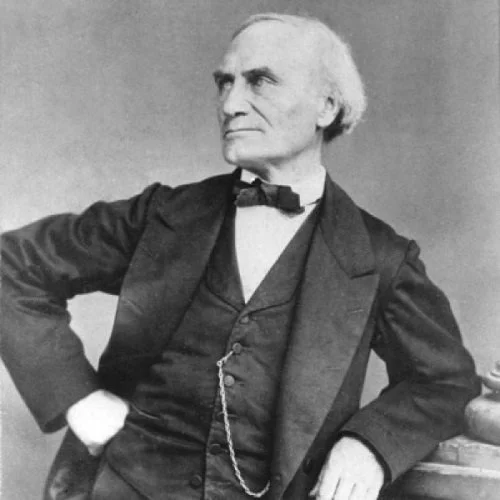
Jean-Eugene Robert-Houdin (1805-1871)
Jean-Eugene Robert-Houdin was a French magician of the 19th century (that means he lived in the 1800s). He was the most famous magician of his time, and in 1856, he used a magic trick to help stop a war from starting.
At his government’s request, Robert-Houdin went to Algeria, which is now a country in Africa but was then a French colony. There was a local group, the Marabouts, who claimed to have magical powers. Robert-Houdin was to demonstrate greater feats than the Marabouts could perform, both to show the Marabouts’ powers were not so amazing and so the Algerians would fear the power of the French. The King of France thought this would make the Algerians not want to fight a war for their freedom.
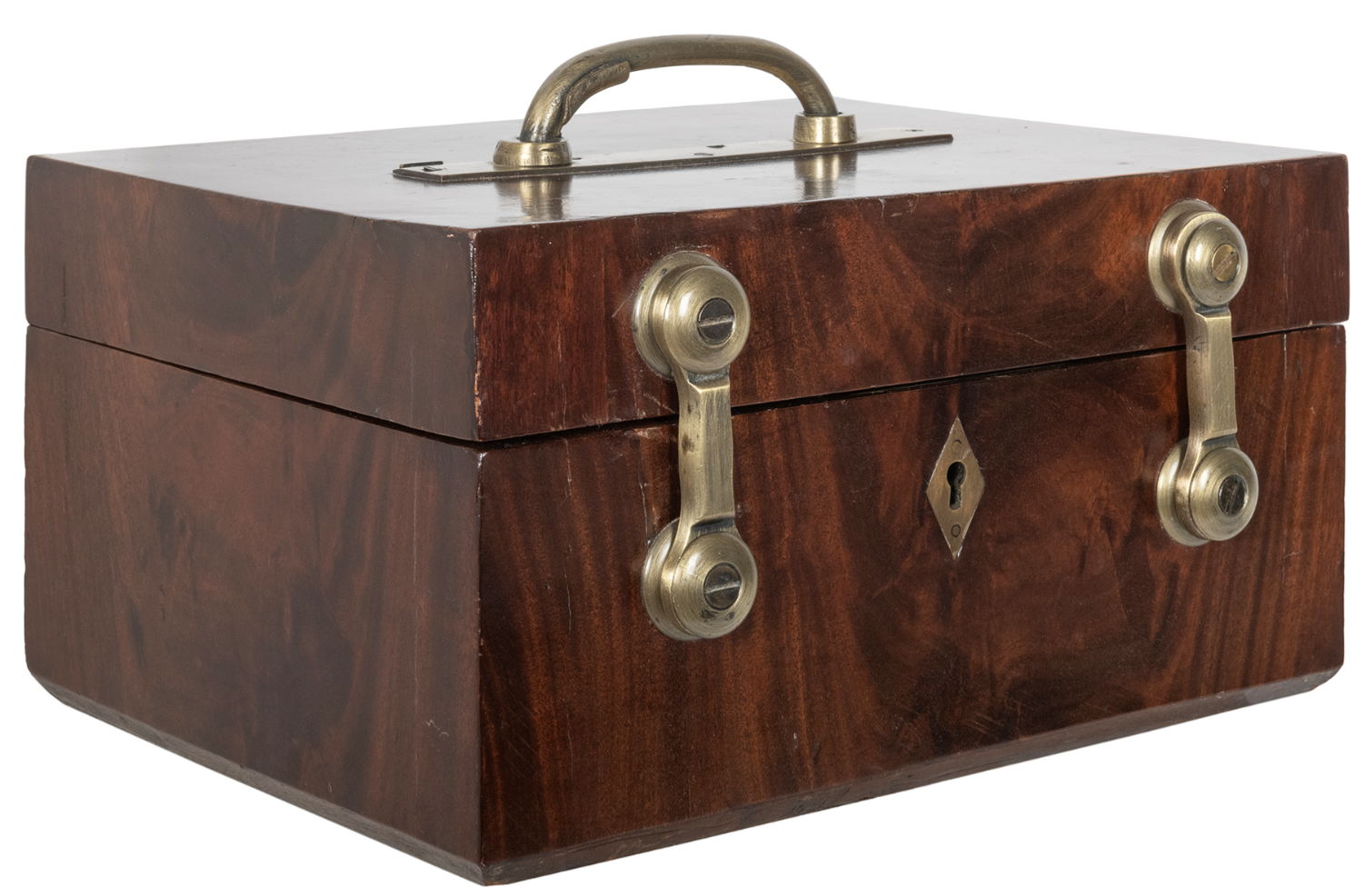
This is the actual box Robert-Houdin used (it has been restored, which means in the last few years someone has made it look nice and less old). It’s a very important artifact to magicians, and in 2021 it sold at auction for more than 100 thousand dollars. It is about the size of a stack of 3 textbooks—but not as heavy (just so long as the solenoid is turned off!).
Robert-Houdin performed lots of amazing magic tricks for the Algerians, but the most incredible one was when he made a very strong Algerian lose his strength. First, Robert-Houdin showed what looked like an ordinary box; a child from the audience was able to lift it with ease. Then Robert-Houdin brought a very muscular Algerian on the stage. Robert-Houdin pretended like he was using real magic to take away the man’s strength; sure enough, when the man tried to lift the box, no matter how hard he tried, he couldn’t budge it at all.
Had Robert-Houdin really made a strongman weaker than a child? Of course not. He used a new technology the Algerians—heck, most people in the world at that time—couldn’t even imagine: electromagnets. By putting a very powerful solenoid under the stage, and then having a helper turn on the solenoid at the right time, the box stuck to the floor of the stage with not magic but magnets.
Robert-Houdin was a magician, but he was an honest magician. He did not want the Algerians to wrongly believe him to have actual magical powers. So after the show, he showed some of the Algerians’ leaders how the trick had worked. They were still very impressed with the great magician’s ingenuity, and the war was averted after all.
By the way, if the name Robert-Houdin sounds a little bit familiar, there’s a reason why! A boy named Ehrich Weiss, born in Budapest, Hungary just 3 years after Robert-Houdin’s death, moved to Wisconsin and grew up loving magic. He admired the great work Robert-Houdin had done, and so when this boy became a professional magician, he changed his name to honor his hero. Ehrich Weiss called himself Harry Houdini, and became the most famous magician in the history of the world.
transistors—impossibly small
Transistors are teeny tiny!
Okay, you probably knew that, since there are BILLIONS of them in an average smartphone. (My iPhone 12 from 2020 has 15 billion transistors in it.) A billion is a 1 with 9 zeros after it. So 15 billion would be written like this: 15,000,000,000.
Numbers that big can be hard to comprehend. If you counted 1 number per second—so it would take you a minute to count to 60, and an hour to count to 3,600—how long would it take to count to 15 billion?
475 years.
In fact, if you started counting when the Declaration of Independence was signed in 1776, you’d only be halfway to 15 billion today.
Okay, so there are a lot of transistors in a phone. That means they’re small. How small?
The average transistor today is 5-10 nanometers in size. (There are different ways to make transistors, and those different methods result in transistors of different sizes.) A nanometer is one billionth of a meter. (A meter is a little longer than three feet.)
So if there are a billion nanometers in a meter and a transistor is 10 nanometers across, that means there are 100 million transistors in a meter. Look at your thumb—it’s about one centimeter in thickness. A centimeter is one hundredth of a meter. That means you would need one million transistors to make a line the length of your thumb’s width. One million!
Another way to think about it—each strand of your hair is 100,000 nanometers thick. (That number means one hundred thousand.) Since transistors are 5-10 nanometers in size, you could fit 10,000 to 20,000 transistors across the width of a single strand of hair.
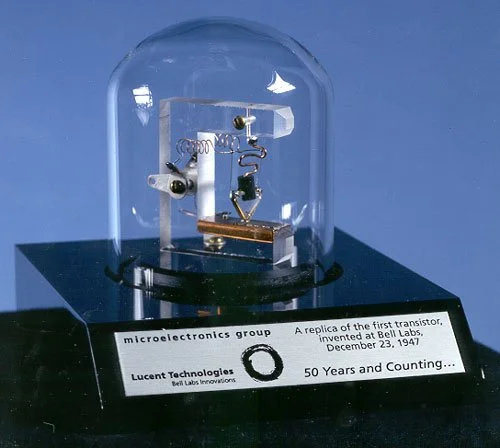
Under the glass dome in this photo is a replica of the first transistor. Could you imagine 15 billion of these? They’d take up a space five times bigger than the size of the moon. If you stacked 15 billion of them on top of each other, you’d make a line that could go from earth to the moon—and back—twice!
This is extra crazy if you know how big transistors used to be. When the first transistor was invented at Bell Labs in 1947, it was 4-5 inches across. If you laid all 15 billion of the tiny transistors from my iPhone 12 in a line, that line would not even make it from one end of that first transistor to the other end.
And transistors are only going to keep getting smaller. In 1965, scientist, engineer and businessman Gordon Moore guessed that transistors would shink 50% in size every two years as technology improved. A lot of people thought that wasn’t possible, but Moore’s Law, as it’s called, has been pretty accurate. It’s likely at some point in the not-too-distant future you’ll be able to buy a phone with more than one TRILLION transistors in it!
But don’t worry. When you do the Calculator Cards trick, you’re only making five transistors. They’re a little bigger than the ones in modern electronics, though!
Make Your Own Calculator Cards
Be a human computer! Make your own Calculator Cards trick and amaze friends and family.
Below are three different ways to make your cards. The simplest and easiest to perform uses three cards, with four numbers on each; these cards can help you figure out a number between 1 and 7. The second set uses four cards with eight numbers on each; they can help you figure out a number between 1 and 15. The third set is my favorite, but has the trickiest math. It’s five cards with 16 numbers on each that can help you figure out a number between 1 and 31.
Choose the version that best fits your comfort level with addition. Depending on the set you’re making, you’ll put these numbers on your card:
Three-card set (easiest):
Card One: 1, 3, 5, 7
Card Two: 2, 3, 6, 7
Card Three: 4, 5, 6, 7
Four-card set (medium):
Card One: 1, 3, 5, 7, 9, 11, 13, 15
Card Two: 2, 3, 6, 7, 10, 11, 14, 15
Card Three: 4, 5, 6, 7, 12, 13, 14, 15
Card Four: 8, 9, 10, 11, 12, 13, 14, 15
Five-card set (hardest):
Card One: 1, 3, 5, 7, 9, 11, 13, 15, 17, 19, 21, 23, 25, 27, 29, 31
Card Two: 2, 3, 6, 7, 10, 11, 14, 15, 18, 19, 22, 23, 26, 27, 30, 31
Card Three: 4, 5, 6, 7, 12, 13, 14, 15, 20, 21, 22, 23, 28, 29, 30, 31
Card Four: 8, 9, 10, 11, 12, 13, 14, 15, 24, 25, 26, 27, 28, 29, 30, 31
Card Five: 16, 17, 18, 19, 20, 21, 22, 23, 24, 25, 26, 27, 28, 29, 30, 31
Remember, you’re only choosing one of these sets of cards to make (don’t try to make and use all three sets at once or the trick won’t work!). And be sure to write your numbers so they’re distinct—don’t write them so close together it becomes hard to tell which numbers are together. (You don’t want someone to miss their number because they thought it was connected to another number!)
Once your cards are made, show your audience the cards and ask someone to think of one of the numbers on one of the cards. Go through the cards one by one and ask if their number is on each. Add the first (smallest) number on the cards that have their number. The sum will be their number.
For example, if you are doing the 3-card version and their number is on the card where the lowest number is 1 and the card where the lowest number is 4, you know 1+4 is 5, so their number is 5. If you’re doing the 5-card version and their number is on the cards where the lowest numbers are 2, 8 and 16, you know their number is 2+8+16, which is 26.
Have fun!
See more magic!
Ready to be amazed? There’s lots of fun stuff on my YouTube channel, youtube.com/ScottGreenMagic. There’s magic I’ve done on TV; magic I’ve done for the Bulls; and magic I’ve done just for YouTube. There’s even a series of science videos, called The Magic Laboratory—although those videos are actually all done by magic, not science, so don’t copy it at home!